
Companies use AI to improve revenue from existing data by connecting their existing sources to a context layer that surfaces revenue signals before the weekly review cycle. Actioneer builds this layer inside your infrastructure, identifies the four signal types that drive EBITDA outcomes, and closes the gap between signal and action within days, not months. This guide explains how the model works and what it actually takes to see measurable revenue uplift from AI.
In this article:
- Why your data is always behind your decisions
- The four revenue signal types that determine EBITDA outcomes
- What the context layer changes about signal speed
- How do companies use AI to improve revenue? The accountability model
- Frequently Asked Questions
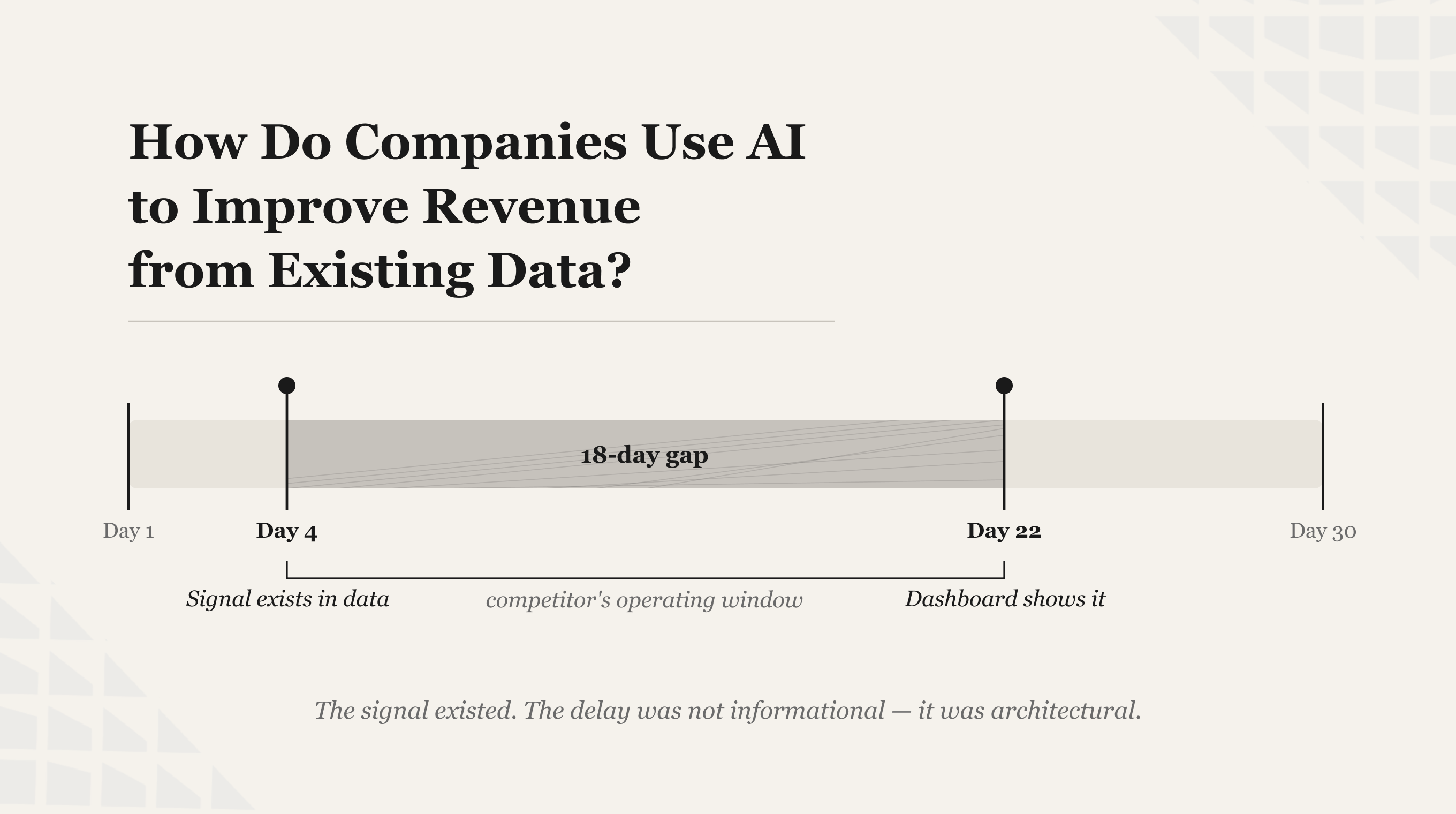
A VP Revenue at a 350-person B2B SaaS company identified a conversion drop in one of her core enterprise segments. The drop had started on day four of the reporting period. Her dashboard surfaced it on day twenty-two. Three weeks is not a reporting lag. It is a competitor's operating window.
How do companies use AI to improve revenue from existing data? They install a context layer that interprets existing data sources accurately enough to surface revenue signals before the weekly review cycle. McKinsey's 2025 State of AI research found that only 20% of organizations are already achieving measurable revenue impact from AI, while 74% aspire to it. The gap between those two groups is a signal speed and data definition problem, not a model capability problem. Actioneer is built to close that gap for companies that use AI to improve revenue but are not yet seeing it in the P&L.
Why Is Your Data Always Behind Your Decisions?
The revenue signal lag is structural. For companies that use AI to improve revenue, this lag is the primary obstacle. Three mechanisms create the delay between when a signal exists in data and when a decision-maker can act on it.
The Analyst Bottleneck
Most revenue signals require SQL queries, multi-source joins, or cross-system aggregations to surface. A question like "which accounts show high product usage but no renewal conversation in the last 45 days?" enters a queue. The analyst writes the query, validates it, formats the output, and returns it , typically 5 to 14 days later. By then, the renewal window has narrowed.
Gartner's April 2026 analysis of AI data foundations found that organizations with successful AI initiatives invest up to four times more in data and analytics foundations than those with poor AI outcomes , and the primary foundation absent in underperforming organizations is not the model, it is the grounding layer that allows queries to run without analyst mediation.
Dashboard Lag and Resolution Gaps
Standard BI dashboards aggregate data into weekly or monthly views, which masks the inflection points where signals form. A segment showing declining conversion in week two of a reporting period will not appear until the end-of-month review. The resolution problem compounds this: dashboards answer questions their builders anticipated. Revenue signals that cross CRM, billing, product analytics, and marketing attribution require queries that no static dashboard can anticipate.
The non-obvious implication: the signal existed. The delay was not informational. It was architectural. Companies evaluating whether to build the retrieval infrastructure internally should consider what building an AI data intelligence layer actually requires before committing to a timeline.
What Are the Revenue Signal Types That Determine EBITDA Outcomes?
Actioneer’s revenue signal framework identifies four types: segmentation signals (customer groups sharing a behaviour pattern), opportunity signals (accounts ready for a new offer), anomaly signals (deviations from established patterns), and experiment signals (tests producing early statistically valid results). Together, these four signal types are the basis of Actioneer’s EBITDA impact model. Each one maps to a specific action a revenue or growth team can take within days of the signal surfacing.
Figure 1: Four revenue signal types.
Segmentation signals identify customer or account groups sharing a behavioural pattern , high engagement without expansion, usage decline before renewal, or purchasing behaviour that predicts churn thirty days before any CRM flag. Surfacing them requires joining product, billing, and CRM data in a single query.
Opportunity signals surface accounts or prospects that meet the conditions for a new offer. Usage-based triggers, cross-sell indicators, and firmographic changes that alter purchasing capacity all fall here. A company that monitors its customers' hiring activity can surface an opportunity signal when a buyer's team expands into the product's value area before any competitor contact.
Anomaly signals flag deviations from established patterns: a segment that typically renews on time but is showing payment delays, a campaign generating traffic but converting at half the historical rate, or a feature adoption gap predicting downgrade. EY's 2025 AI Pulse Survey found that 96% of AI-investing organizations report productivity gains from AI , but only 57% report significant gains. The gap maps directly to organizations that act on segmentation and opportunity signals ahead of the reporting cycle versus those that only respond to anomalies after the fact.
Experiment signals track whether a test (pricing variation, message change, feature rollout) is producing a statistically valid result faster than the scheduled review date. This is one of the most underused ways companies use AI to improve revenue from existing data. An AI layer monitoring experiment signals can surface early evidence of a winning condition, or an early negative, before the full test period closes. These four signal types form Actioneer’s proprietary revenue signal framework, developed from deployments across BFSI and consumer businesses. They are not a generic industry taxonomy. They are the lens Actioneer uses to scope every engagement and measure every outcome.
For organizations operating in regulated environments, including BFSI in India and financial services in the EU, the question of how to deploy AI on confidential data without compromising data residency is a prerequisite before any signal-surfacing deployment. Actioneer's on-premise and private cloud deployment options address this directly.
What Does the Context Layer Change About Signal Speed?
The context layer is the component that allows an AI system to query a company's data accurately and without mediation. Without it, the AI does not know what "active customer" means for a specific business, which data source is authoritative for revenue, or how to join the CRM to the billing system with the company's own metric definitions intact. With it, companies use AI to improve revenue from existing data by getting a verified query result in seconds rather than a queued request.
Actioneer connects to existing data sources, CRM, data warehouse, billing platform, product analytics, and marketing tools, and builds the context layer within the company's own infrastructure. The context layer is not a separate system replacing what already exists. It is an interpretive layer on top of existing sources, so product, engineering, and data science teams keep ownership of their pipelines.
The signal-to-action model that results is precise: the context layer surfaces the signal type: segmentation, opportunity, anomaly, or experiment. The campaign team or revenue leader acts on it. That separation keeps the context layer's role measurable and keeps accountability with the business owner, not the tool.
When companies use AI to improve revenue from existing data without a context layer, the AI produces outputs the business cannot act on. For companies evaluating which AI implementation structure fits their operating model, the analysis of how Actioneer's outcome accountability model works in practice covers the scoping, timeline, and weekly review cadence in detail.
How Do Companies Use AI to Improve Revenue? The Accountability Model
The 15% revenue uplift cited across AI deployments traces to a specific operational condition: a defined revenue signal type, a named business owner, a baseline measurement, and a weekly review that closes the loop between signal surfaced and action taken. Companies that use AI to improve revenue from existing data do not need new data. They need to close the delay between signal and action in data that already exists.
McKinsey's 2025 State of AI research found that AI-driven business transformations delivered a 20% EBITDA uplift, reached breakeven in one to two years, and generated $3 of incremental EBITDA for every $1 invested, in organizations that set growth or innovation as the AI initiative's primary objective, not efficiency alone. The separating factor was workflow redesign: these organizations rebuilt the signal-to-action workflow, not just the analytics layer.
Accuracy is what determines whether companies use AI to improve revenue or just improve their dashboards. The DABstep benchmark (450+ real-world financial data reasoning tasks developed by Hugging Face and Adyen) placed Actioneer v0.5 at 93.78% accuracy overall, including 94.44% on the hard task set. Single-agent platforms score between 52% and 68% on the same tasks. The accuracy difference is a production reality: segmentation signals and anomaly detections that require multi-source joins and sequential reasoning either surface correctly or they do not, and architecture, not model selection, determines which.
The accountability model has three required inputs from the business owner: a named revenue signal type to target first, a baseline measurement before deployment, and a fixed weekly review cadence. Organizations that enter AI deployments without those three elements consistently produce the result McKinsey identified: widespread adoption, unmeasurable EBITDA impact.
Frequently Asked Questions
What are Actioneer’s four revenue signal types?
Segmentation, opportunity, anomaly, and experiment. These are Actioneer’s proprietary signal types, not a generic industry taxonomy. Each one maps directly to a revenue action: a campaign push, a cross-sell trigger, a churn intervention, or an early call on a running test. They are the framework Actioneer uses to scope every engagement and report on every outcome.
What does it take to build a context layer internally?
Schema mapping across every data source, a metric definition layer your whole team agrees on, query validation logic, and enough engineering bandwidth to maintain it as your data stack changes. Most teams scope this at 3 to 6 months. Most teams are still scoping it 6 months later. Actioneer is live in two weeks because the grounding layer is built and maintained as part of the managed service, not handed off to your engineering queue.
How quickly does Actioneer go live?
Two weeks from kickoff to live signals. Actioneer connects to your existing data sources, maps your metric definitions, and builds the context layer within your own infrastructure. No data migration, no pipeline rebuild. Week one is connection and grounding. Week two is validation and first signal output.
Who owns the implementation, and what does the business need to provide?
Actioneer owns the implementation. The business needs to provide three things: data source access, a named revenue signal type to target first, and a business owner who joins the weekly review. Actioneer scopes the use case, runs the deployment, and reports against a baseline. It is a managed service, not a SaaS handoff where your team figures it out.
Does Actioneer work for regulated industries like BFSI?
Yes. On-premise and private cloud deployment keeps all data processing within the organization’s own infrastructure. Actioneer is SOC 2 Type II certified and ISO 27001 compliant. Every answer includes the SQL query used, so outputs are auditable by design. For Indian organizations, this satisfies RBI and DPDP Act requirements. For EU deployments, equivalent frameworks apply. Compliance and accuracy point toward the same architecture.
What does good look like in the first 90 days?
Live signals within two weeks. A measurable reduction in signal-to-action lag by week four. A documented baseline and first revenue attribution by day 60. By day 90, the highest-priority signal type is running on a defined playbook, the business owner has weekly review data to act on, and the team can point to a specific number that moved. That is the standard Actioneer holds itself to on every deployment.
Actioneer's data intelligence platform surfaces the revenue signals buried in existing data and connects them to the decisions and campaigns that move EBITDA. For companies that use AI to improve revenue from existing data and want measurable EBITDA impact, the first step is identifying the highest-priority signal type and building the accountability model around it. Start that conversation at actioneer.com.
SLUG: /ai-improve-revenue-existing-data
META DESCRIPTION: How companies use AI to improve revenue from existing data: four signal types and a context layer model that closes the gap between signal and action.
TAGS: AI for revenue growth, revenue signal AI, AI data context layer, EBITDA AI impact, enterprise AI revenue, Actioneer
Author: Sashank Vandrangi