
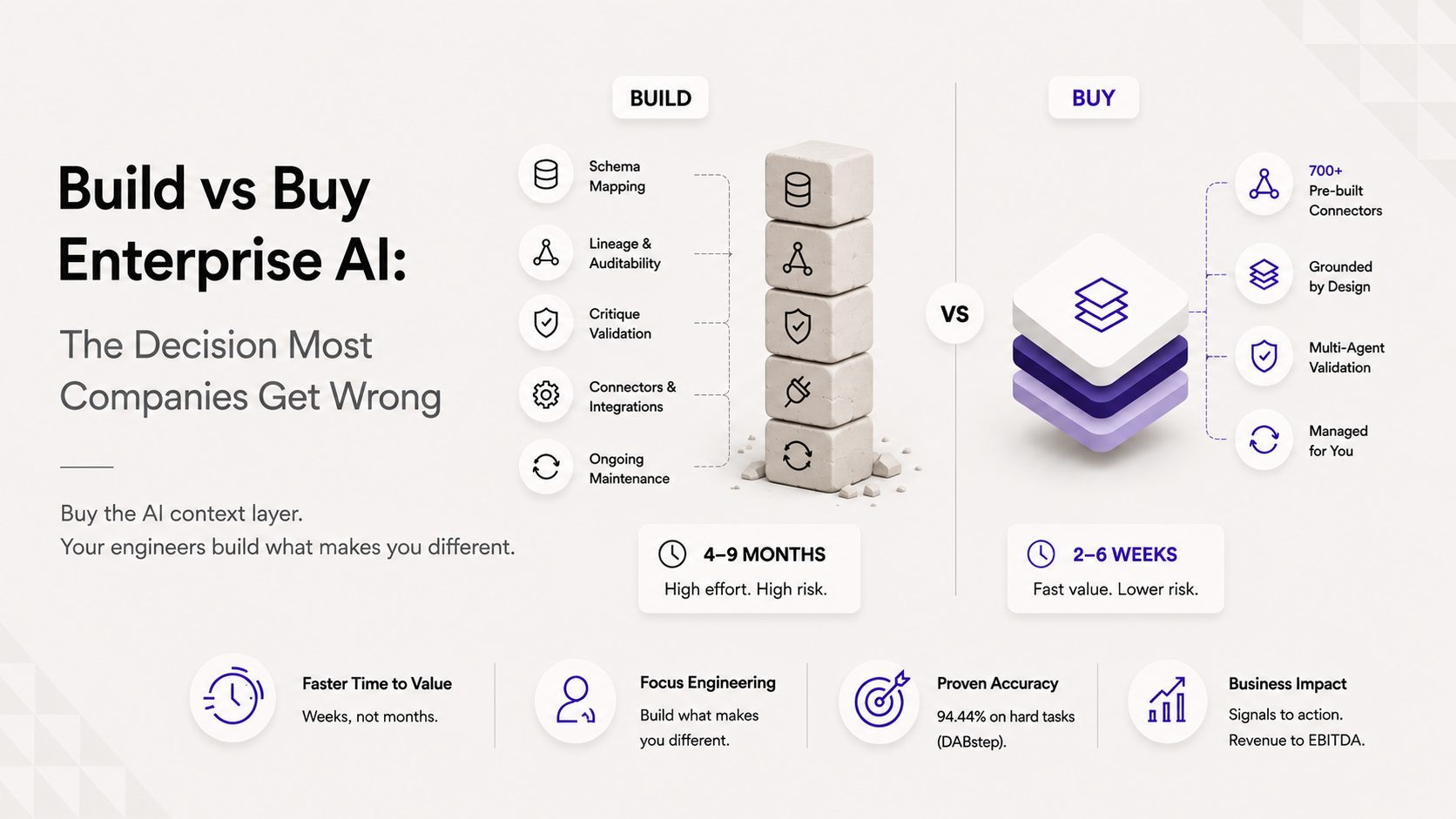
For most companies with 200 or more people, buying an enterprise AI context layer is the better call. Actioneer deploys reliable AI on company infrastructure in 2 to 6 weeks. A custom internal build of equivalent quality typically takes 4 to 9 months and the hidden cost to do so is often not even considered at the time of deciding between build vs buy.
Building a production-grade text-to-SQL intelligence layer demands sustained engineering investment in schema mapping, lineage tracking, and validation infrastructure before a single reliable query runs. Gartner's April 2026 analysis of AI data foundations confirms that organizations with successful AI initiatives invest up to 4x more in data and analytics foundations than those that fail. Actioneer provides the enterprise AI context layer for companies that cannot afford to spend those months in the build queue.
The choice between building and buying is not primarily about cost. It is about whether the company has the engineering capacity, the data readiness, and the timeline to reach production before the business pays for the delay.
What Does Building an AI Context Layer for your Enterprise Actually Require?
Building a reliable AI context layer requires substantially more than connecting a large language model to a database. The infrastructure that determines output reliability sits beneath the model, and it must be built from scratch.
Text-to-SQL Grounding: What It Takes to Build, Maintain, and Improve
Connecting an LLM to a database does not make it reliable. The reliability comes from a grounding layer, the infrastructure beneath the model that traces every output to a specific table, query, and data state.
Building this from scratch requires schema documentation, metric definition, and lineage architecture before a single production query can run. And it does not stop at launch. Schema changes, new data sources, and model version updates require continuous maintenance, not a one-time project. Grounding is where that investment goes, and where internal builds most consistently run over time and budget.
Schema Mapping: The Upfront Work of Connecting Sources and Defining Metrics
Schema mapping is the process of translating a company’s data structure into terms an AI system can interpret reliably. Every table relationship, metric definition, and business logic rule must be formally documented before any query can be tested.
For a company with eight data sources, a CRM, billing system, marketing platform, and product analytics tool, this exercise typically takes four to eight weeks of senior engineering time. The more fragmented the data stack, the longer this takes. Without it, an AI system can return plausible-sounding answers that are not traceable to actual data. Gartner’s February 2025 research identified lack of AI-ready data as the primary reason 60% of enterprise AI projects are abandoned before delivering value. Schema mapping is where that gap lives.
Lineage and Auditability: How to Ensure Every AI Output Is Traceable to a Source
A grounded system cannot return an answer it cannot prove. Lineage architecture records the specific table, query, and data state behind every output so teams can audit results, correct errors systematically, and rely on the system for decisions with real financial or operational consequences.
For companies in regulated sectors, banking, lending, insurance, auditability is not optional. It is a day-one requirement. Building it into an internal system adds significant scope to an already demanding timeline. Without lineage, teams have no mechanism to distinguish a correct AI output from a confident-sounding one. That distinction matters every time someone acts on the result.
The Critique Validation Layer: Why Single-Agent Systems Fail on Complex Queries
Enterprise data questions rarely involve single lookups. A question like "Which customer segments showed declining gross margin in Q1 despite volume growth?" requires multi-table joins, sequential reasoning, and domain-specific logic that must be validated before the result is returned.
A single-agent architecture, where one model generates one answer, produces unreliable outputs on these hard queries. A multi-agent critique layer introduces a secondary agent that reviews the primary output, validates the generated SQL against the schema, and flags contradictions before the result reaches the business user.
The accuracy difference between the two architectures is not marginal. Actioneer's agent achieved 94.44% accuracy on the DABstep hard set - a benchmark of 450+ multi-step financial data reasoning tasks developed by Hugging Face and Adyen. Single-agent platforms score between 52% and 68% on the same tasks.
Ongoing Maintenance: The Commitment That Continues After Launch
Schema changes, new data sources, model version updates, and connector drift require continuous maintenance. McKinsey's 2025 analysis of agentic AI infrastructure identifies ongoing maintenance cost as one of the most consistently underestimated elements of internal AI builds. A company that builds its own intelligence layer is committing to a sustained engineering function, not a one-time project.
The honest question for any engineering leader: is this the best use of the team's capacity over the next 12 months?
What Should Your Engineers Actually Build?
Enterprise AI data systems have two distinct layers. The three components covered above, grounding, schema mapping, and lineage, are all part of the same layer: the infrastructure that makes AI on enterprise data reliable. It is complex to build, slow to validate, and expensive to maintain. It is also the layer that most internal builds get stuck in for quarters before anything reaches production.
With today’s AI coding tools, an engineering team can build an agent, connect it to data sources, and run a multi-step workflow in a matter of days. The problem is not that they cannot build the infrastructure layer too. It is that every month they spend building it is a month they are not working on the layer only they can define: the use cases, the revenue logic, the risk rules, the customer segmentation models, the cross-sell triggers, and the growth experiments that require domain expertise no platform can supply.
This is the build trap. Not that companies try to build AI, but that their best engineers end up solving infrastructure problems that every enterprise faces in roughly the same form, when that work has already been done. Actioneer owns the grounding, schema mapping, critique validation, connector library, and maintenance overhead described above. The business keeps its engineering capacity for the second layer: the work that is specific to them and that actually creates competitive advantage.
The decision, framed correctly, is not a question of capability. It is a question of where engineering time creates the most value. The comparison below makes that concrete.
Build vs Buy Enterprise AI: An Eight-Dimension Comparison
The non-obvious dimension in this table is ongoing maintenance. Internal builds require indefinite engineering allocation - connector updates, schema version changes, model refresh cycles, and prompt maintenance. That cost is rarely included in the initial build vs buy infrastructure calculation, and it consistently appears in post-mortems as the factor that made the build path more expensive than projected.
| Dimension | Build (Internal) | Buy (Enterprise AI) |
|---|---|---|
| Time to first reliable output | 4–9 months | 2–6 weeks |
| Engineering resource required | 2–4 senior engineers, sustained | Implementation support only |
| Data source connectors | Built per source, one at a time | 700+ pre-built connectors |
| Grounding and lineage | Must be designed and built | Included in the context layer |
| Multi-agent critique layer | Must be designed and benchmarked | Included, third-party verified |
| Hard-task benchmark accuracy | Unknown until in production | 94.44% (Actioneer, DABstep) |
| Ongoing maintenance | Continuous engineering allocation | Managed by vendor |
| Right for whom | Teams with dedicated AI infra capacity and 12+ month timelines | Companies needing reliable AI on their data within weeks |
Why Does Benchmark Accuracy on Real-World Tasks Matter More Than Demos?
Benchmark accuracy on domain-relevant tasks predicts production performance more reliably than any vendor demonstration. A demo uses curated data, selected queries, and rehearsed outputs. A rigorous third-party benchmark does not.
What DABstep Tests and Why It Is a Harder Measure
The DABstep benchmark was built by Hugging Face and Adyen to test AI agents on real-world financial data tasks requiring multi-step sequential reasoning. The 450+ tasks in the benchmark include multi-table joins, cross-source aggregations, and domain-specific calculations that mirror the queries business users actually ask.
There are no one-question, one-table lookups in the benchmark. Every task requires the kind of reasoning that matters in a production environment.
What the Current Leaderboard Shows
Actioneer v0.5 ranked first overall on the DABstep leaderboard with 93.78% accuracy, including 94.44% on the hard set. Nvidia KGMON scored 89.56% overall. Microsoft 365 Copilot scored 68%. Google DS-Star scored 52%.
The 26-percentage-point gap between Actioneer and Microsoft on hard tasks is a production reality, not a benchmark abstraction. MIT Sloan's research on generative AI deployment paths confirms that benchmark accuracy on domain-specific tasks is the most reliable predictor of whether AI delivers value in production, ahead of feature set, UX quality, and demo performance.
For Mid-to-Large Companies, Buying Is Usually the Better Call
Building is not the wrong answer for every company. Teams with dedicated AI infrastructure capacity, a 12-month runway, and a narrow initial use case can make the build path work. But for most mid-to-large organisations, those conditions do not exist at the same time. Engineering capacity is already allocated. Data sits across six or more fragmented sources. Business leaders need results in weeks, not quarters. In that context, buying an enterprise AI removes the three variables that most commonly cause internal builds to stall: data readiness, grounding architecture, and ongoing maintenance overhead. The build path is a viable choice. For the majority of companies evaluating it honestly against their actual constraints, buying is the faster, lower-risk route to reliable AI on their data.
Frequently Asked Questions
How long does it actually take to build an AI data intelligence system from scratch?
For a company with six or more data sources, building a production-grade text-to-SQL system typically takes four to nine months of sustained engineering effort. This estimate covers schema mapping, grounding layer development, critique validation architecture, and initial connector builds. Projects that assume shorter timelines consistently underestimate the mapping and lineage work required before production queries are reliable.
What is the DABstep benchmark and why does it matter for enterprise AI decisions?
DABstep is a benchmark developed by Hugging Face and Adyen that tests AI agents on 450+ real-world financial data tasks requiring multi-step sequential reasoning. Actioneer v0.5 ranked first overall with 93.78% accuracy, including 94.44% on the hard set. It is currently one of the few benchmarks that uses genuine multi-step financial data tasks rather than simplified academic examples, making it a more meaningful predictor of production performance.
Can a company buy an enterprise AI and retain its existing data science team?
Yes. An enterprise AI augments an existing data science pipeline rather than replacing it. The context layer handles natural language queries, schema mapping, and output validation; the data science team continues to own model development, experimentation, and analytical work. Actioneer is explicitly designed for this augmentation use case.
Why do most enterprise AI projects fail to reach production with measurable business impact?
An MIT Technology Review analysis found that 95% of generative AI pilots are not delivering expected value. The most common causes are data readiness failures, the absence of a grounding layer, and significant underestimation of build scope at the point the project is approved. Buying an enterprise AI that includes grounding and lineage by design removes the first two causes directly.
What does the critique validation layer actually do in an AI data system?
The critique layer is a secondary agent that reviews the primary agent's output before it is returned. It validates the generated SQL against the schema, checks the logical steps in the reasoning chain, and flags gaps or contradictions. This architectural addition is the reason Actioneer scores 94.44% on the DABstep hard set while single-agent systems score 52–68% on the same tasks.
What does "grounding" mean in an enterprise AI data context?
Grounding means tracing every AI output to a verified source: a specific table, a specific query, a specific data state. A grounded system cannot return a plausible-sounding answer that is not traceable to actual data. Without grounding, teams cannot audit AI outputs, cannot correct errors systematically, and cannot rely on the system for decisions with financial or operational consequences.
Companies that are still waiting for an internal AI build to reach production are not waiting because the engineering team is weak. They are waiting because the build path, done correctly, takes longer than anyone estimated at the start. Actioneer's context layer is built for companies that have real AI ambitions and cannot afford to lose another quarter to infrastructure work. Speak with the Actioneer team to see what deployment on actual company data looks like within 90 days.