
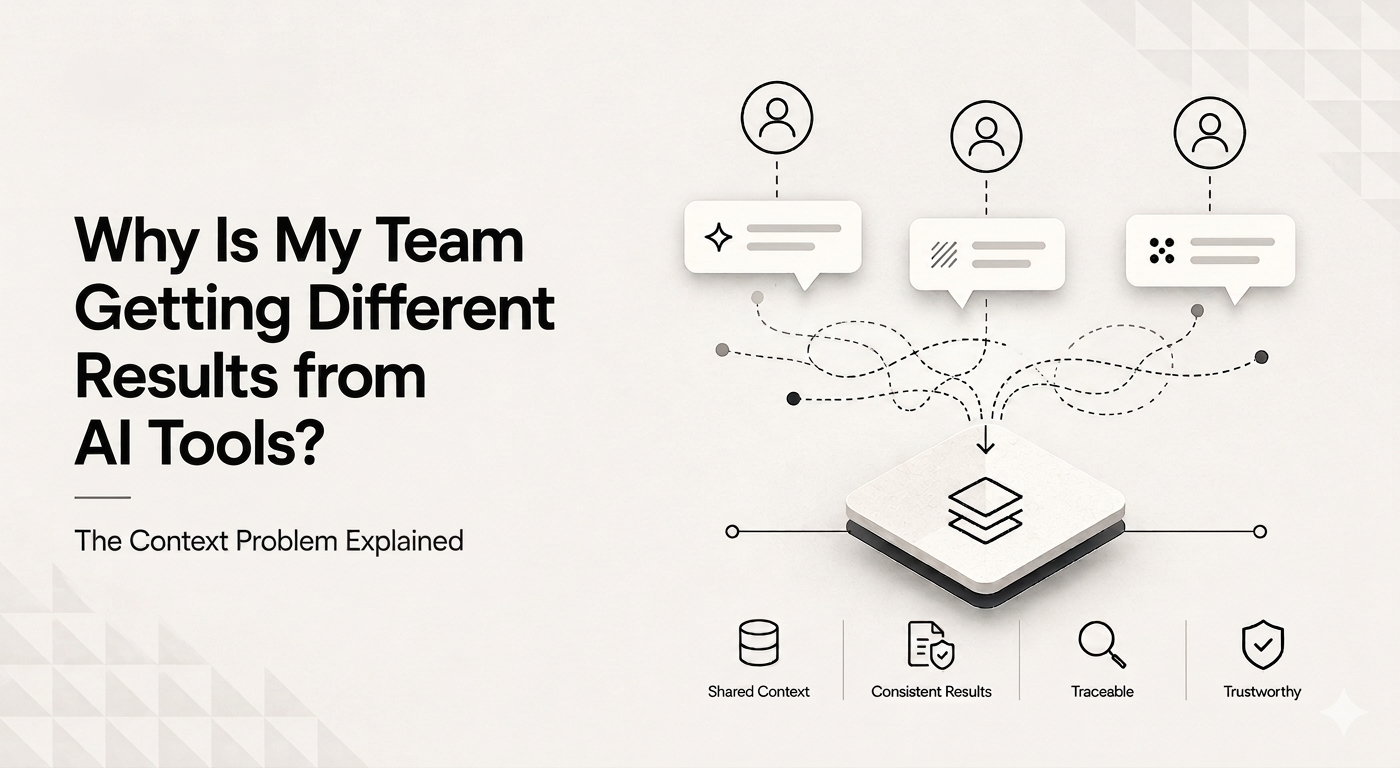
Getting different results from AI tools across a business team is a context problem, not a model problem. Actioneer builds the grounding layer that encodes an organisation's metric definitions, authoritative data sources, and business logic, making AI outputs consistent, traceable, and trustworthy for decisions. This guide explains the root cause, why the standard hallucination diagnosis misses it, and what changes when a context layer is in place.
In this article:
- Why is my team getting different results from AI tools?
- What is context, and why does AI not have it?
- How does grounding make AI outputs trustworthy?
- What does context enable beyond accuracy?
- Frequently Asked Questions
A VP Revenue at a 600-person SaaS company asked two questions on the same afternoon: how many enterprise accounts upgraded last quarter, and which segments showed the highest expansion potential for the current month. Both questions drew on data the company already owned. One AI tool returned a figure she could not verify against the CRM. Another returned a completely different figure. A third gave a number using a customer classification the team had retired eight months earlier.
Why is my team getting different results from AI tools? In short, the AI does not know what the business means by the terms it uses. McKinsey's November 2025 State of AI research found that only 39% of organisations report EBIT impact at the enterprise level from AI use, and the gap between that 39% and the rest traces to the presence or absence of a grounded context layer, not model capability. Actioneer builds that layer inside an organisation's own infrastructure so every AI output traces to a verified source.
Why Is My Team Getting Different Results from AI Tools?
The Hallucination Diagnosis Gets It Wrong
Hallucination - where a model generates confident-sounding output not grounded in real data , occurs when the AI has no verified source to draw from. The model fills the gap with inference. Most inconsistent business AI outputs, however, are not hallucinations in this sense. The data exists. The problem is that the AI cannot reliably interpret what the data means for a specific organisation.
When the same question returns different answers across tools or team members, the cause is usually one of three things: there is no agreed definition of the metric being queried, the AI draws from the wrong source because no source has been designated as authoritative, or the business logic governing a calculation is invisible to the AI.
None of those are model failures. They are grounding failures. Diagnosing them as hallucination leads to the wrong fix — better prompts, different models — when the correct solution is a context layer.
Gartner's February 2025 research on AI project risk found that 60% of enterprise AI projects will be abandoned before delivering value, with the primary cause identified as absent AI-ready data, not AI capability. The data management practices that ground AI reliably are absent in 63% of organisations surveyed. The AI tools exist. The grounding does not.
What Is Context, and Why Does AI Not Have It?
Context, in business AI terms, is the structured knowledge that tells an AI system what an organisation's data actually means: which source is authoritative for revenue, what the company's definition of an active customer is, how segments are constructed, and what business logic governs calculations that affect decisions.
The Business Buyer Version
Without context, an AI system encountering "churn rate" has no way to know whether the business calculates it on 30-day inactivity, subscription cancellation, or logo loss. Without context, "top accounts" might be sorted by ARR, recent activity, or industry segment. The AI selects based on general patterns in training data, not the company's specific definition.
Developer tools such as LangChain, vector databases such as Pinecone, and cloud AI services from AWS do not solve this problem. Those tools handle retrieval and processing. They do not install a layer that encodes what a specific business means by the information it stores.
Context is the knowledge layer, not the query engine. Harvard Business Review's February 2026 analysis identified this directly: when every company can access the same AI models, context becomes the competitive advantage. The models are commoditised. The context is not. An organisation that builds a proprietary context layer owns something no competitor using the same AI tool can replicate.
What the Absence of Context Looks Like in Practice
Three patterns signal a context gap rather than an AI capability gap.
Inconsistent answers to the same question across tools or team members. Each query is interpreted independently, using whatever the model can access without a verified definition. Context standardises the interpretation at the source.
Correct numbers, outdated frame. The AI returns a real figure from real data, applying a segment definition or product classification the business no longer uses. The output is not hallucinated, it is grounded in stale context.
Drift without explanation. Business logic changes. Revenue recognition policies shift. An AI system without a maintained context layer continues applying old logic silently, until a downstream error surfaces the inconsistency.
For organisations operating on sensitive data like BFSI in India, financial services in the EU, the context gap carries compliance implications beyond business reliability. The guide on deploying AI on confidential data explains how grounding and audit trail requirements overlap in regulated environments.
How Does Grounding Make AI Outputs Trustworthy?
Grounding is the architectural property that ensures every AI output traces to a verified source: a specific query against a specific data source at a specific point in time. A grounded system cannot return a plausible-sounding answer that is not traceable to actual data. If the query cannot be shown, the result is not grounded.
Text-to-SQL and What It Actually Does
Text-to-SQL converts a natural language business question into a verified database query. Without a context layer, text-to-SQL produces queries that are technically valid but semantically incorrect: the wrong table, the wrong join condition, or the wrong time window, because the AI lacks the business definitions to distinguish between them.
With a context layer, the natural language query is interpreted against verified metric definitions, authoritative source assignments, and business logic rules before any query is generated. The output is not just a number but is a number with a traceable path to the exact data that produced it.
What the DABstep Benchmark Reveals About Architecture
The DABstep benchmark which took 450 real-world financial data reasoning tasks developed by Hugging Face and Adyen, tests AI agents on multi-step, multi-source queries that businesses actually run.
Actioneer v0.5 ranked first overall at 93.78% accuracy overall and 94.44% on the hard task set. Single-agent systems and architectures without a critique validation layer score between 52% and 68% on the same tasks. Microsoft 365 Copilot scored 68%. Google DS-Star scored 52%.
The 26-percentage-point gap on hard tasks is a production reality. Multi-step revenue and segmentation queries require sequential reasoning with domain-specific logic that single-agent architectures fail on at a rate that makes them unsuitable for revenue decisions.
Organisations evaluating whether to build this architecture or purchase it should review what building an AI data intelligence layer actually requires typically four to nine months of sustained engineering investment before a single reliable production query runs.
What Does Context Enable Beyond Accuracy?
Accuracy is the baseline requirement for AI to be useful in business decisions. A grounded context layer enables two capabilities that compound from it.
Standardised Outputs Across Teams
When every team member queries the same context layer, outputs converge. The VP Revenue, the analyst, and the regional director asking the same underlying question draw from the same metric definitions, the same segment logic, and the same authoritative source. The context layer becomes the shared source of truth for the organisation's own data.
This is the inverse of the inconsistency problem. Instead of different people getting different outputs from different AI tools, the context layer produces a standardised vocabulary and AI applies that vocabulary consistently regardless of who is asking or what interface they use.
Forrester's 2026 enterprise AI predictions identified knowledge grounding as the separating factor between AI deployments that reach production value and those that stall, with the instruction to "decide where your agents live and where your knowledge lives, and invest in the infrastructure that keeps your outputs real." The infrastructure is the context layer.
AI Skill Governance as a Concept
The inconsistency problem scales into an organisational problem when no shared context exists. Different team members prompt AI differently, draw on different tools, and produce outputs the organisation cannot reconcile. There is no visibility into which workflows are producing reliable output, which team members are using AI effectively, or which approaches are worth standardising.
AI Skill Governance is the organisational capability that emerges when a shared context layer makes AI outputs auditable and comparable. When every query is grounded in the same verified definitions, the organisation can identify which workflows produce value, standardise the ones that work, and close the gaps. The context layer is the technical prerequisite; governance is what becomes possible when that prerequisite exists.
The revenue accountability model that operationalises this - named business owner, defined signal type, weekly review cadence - is laid out in Actioneer's framework for using AI to improve revenue from existing data. Organisations still deciding how to implement the context layer can review the comparison of managed AI implementation against the build and buy paths for the timeline and resource implications of each approach.
Frequently Asked Questions
Why does my team get different results from the same AI tool?
Different results from the same AI tool indicate the absence of a shared context layer. Each query is interpreted independently, using whatever data the model can access without a verified definition of what that data means for the specific business. When the AI encounters ambiguous terms - segment names, revenue definitions, customer classifications - it resolves them using general patterns from training data rather than company-specific logic. A context layer encodes those definitions and ensures every query draws from the same authoritative source.
What is the difference between AI context and training data?
Training data is what a model learned from before deployment. Context is the verified, organisation-specific knowledge governing how the model interprets queries about a specific business. A model trained on general data has learned language patterns and reasoning capability. A model with a context layer knows what a specific company means by "active customer", "top account", or "monthly recurring revenue" and applies that definition consistently. Training data cannot be customised per company. Context can and should be.
How long does it take to build a context layer?
Building a context layer internally - documenting schema, designating authoritative sources, encoding metric definitions, and constructing grounding infrastructure typically takes four to nine months for a company with six or more data sources. Actioneer deploys the context layer within the company's own infrastructure in two to six weeks, supported by implementation specialists and 700-plus pre-built data connectors.
Does a context layer replace a data analyst or data team?
No. The context layer handles the interpretive layer: ensuring natural language queries return verified, traceable answers. Analysts and data science teams continue to own modelling, experimentation, hypothesis generation, and analytical strategy. The change is in the queue — questions that previously required an analyst to write SQL and schedule a report are answered immediately through the context layer. The analyst's capacity moves to higher-value work.
What is AI Skill Governance and why does it matter?
AI Skill Governance is the organisational capability to identify which AI workflows are producing reliable output, standardise the ones that work, and close the gaps. Without a shared context layer, different team members produce outputs the organisation cannot compare because the underlying definitions differ across tools and prompts. With a context layer, outputs become auditable: grounded in the same definitions, traceable to the same sources, comparable across teams. Governance becomes possible when outputs are consistent enough to evaluate systematically.
Can a context layer work across multiple data sources at once?
Yes — that is its primary function. Most meaningful business questions require joining data across CRM, billing, product analytics, and marketing attribution. A context layer defines the relationships and metric logic across those sources, so a natural language query automatically draws from the correct combination, applies the correct logic, and produces a traceable output. This is what single-source BI tools cannot do, and what analyst-queue approaches do slowly.
Actioneer's data intelligence platform builds the context layer inside an organisation's own infrastructure, grounded in that company's metric definitions, authoritative sources, and business logic. Founders, VPs Revenue, and VPs Growth ready to address inconsistent AI results and connect their data to the decisions that act on it can start the conversation at actioneer.com.
SLUG: /why-is-my-team-getting-different-results-from-ai-tools
META DESCRIPTION: Why is my team getting different results from AI tools? It is a context problem. Actioneer's grounding layer makes AI outputs consistent and reliable.
TAGS: AI context layer, enterprise AI consistency, why AI gives different results, AI grounding business, context layer for AI, Actioneer